
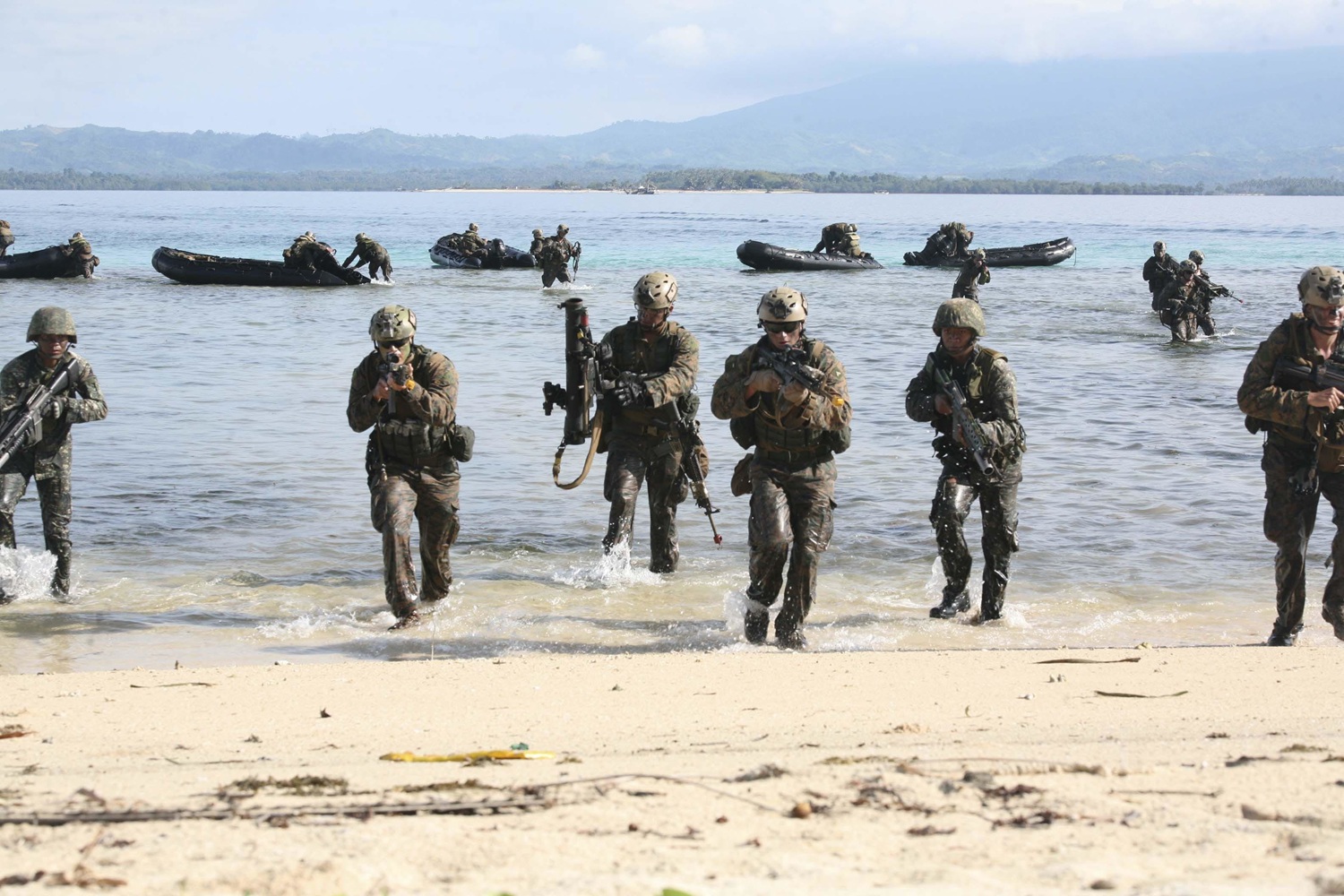
The United States has announced the deployment of 2,500 Marines with the aim of taking control of the Strait of Hormuz and ensuring freedom of international navigation in order to prevent a global oil crisis caused by the U.S.–Israeli war against Iran. However, the military reality indicates the difficulty of carrying out such a mission, which may remain theoretical, similar to a commando operation aimed at seizing Iran’s enriched uranium.
Washington revealed to the Associated Press that about 2,500 U.S. Marine Corps troops, belonging to the 31st Marine Expeditionary Unit, along with the amphibious assault ship USS Tripoli, have received orders to deploy to the Middle East, specifically near the Strait of Hormuz, coming from Japanese waters.
From a historical perspective, the Marine vessel bears the name Tripoli, a designation derived from the famous Battle of Tripoli in 1804, which pitted American forces against the naval forces of Tripoli in Libya after Washington refused to pay tribute to prevent its ships from being attacked. This operation is also mentioned in the Marine Corps Hymn.
This ship is essentially a small aircraft carrier, capable of transporting 1,600 troops along with approximately 25 aircraft and helicopters.
The Marines are considered one of the elite forces of the U.S. military. They receive very high-level training, closer to that of commando forces than to traditional military training. This allows them to deploy rapidly, conduct amphibious landing operations, and carry out rapid combat operations. However, in the case of the Strait of Hormuz, the situation is different.
Perhaps the first concrete element is what The Wall Street Journal reported on March 15, 2026, stating that the Chairman of the Joint Chiefs of Staff, General Dan Caine, had informed U.S. President Donald Trump of the possibility that Iran might close the strait if it were attacked. In practice, this seems to be happening now, although the closure remains selective, as the authorities in Tehran allow certain countries, such as China and India, to pass their ships while preventing others from doing so.
The general’s warning is based on field data and serves as an early indication that Iran has the capability to close the Strait of Hormuz, as well as an acknowledgment that a U.S. operation to take control of the strait would be extremely difficult, if not impossible. This difficulty is reflected in the following factors:
First, the Pentagon was aware of this realistic scenario, since it constitutes a form of leverage for Tehran, according to The Wall Street Journal. Despite this, the Pentagon had not developed a prior plan to reopen the strait. On the contrary, the deployment of Marine forces came after the closure, whereas logic would have required them to already be present in the region. This may indicate that the decision to go to war was taken quickly, without waiting for the necessary preparations, or that it resulted from a miscalculation of Iran’s power. President Trump believed that Iran would capitulate before closing the Strait of Hormuz.
Second, in Bahrain, where the headquarters of the U.S. Fifth Fleet is located, three ships are present, according to the magazine of the U.S. Naval Institute: the littoral combat ships USS Canberra (LCS-30), USS Tulsa (LCS-16), and USS Santa Barbara (LCS-32). These vessels are part of the U.S. Navy’s first operational task groups dedicated to mine countermeasure operations. They carry out missions similar to those of the Marines and even have Marine units on board. However, they are currently not patrolling the waters of the Gulf, as they are stationed to confront Iranian missiles and drones, since sailing would expose them to danger.
These relatively light warships already have a sufficient number of troops and considerable firepower, meaning that it is not necessarily necessary to wait for the arrival of additional Marine forces. In fact, about 30,000 American soldiers are currently deployed in the Middle East, including Marine units in several Gulf countries, particularly in the United Arab Emirates and Bahrain.
Third, all U.S. ships have moved away from the Strait of Hormuz to avoid potential Iranian attacks, including the aircraft carrier USS Abraham Lincoln, which has withdrawn far from the Arabian Sea, while Tehran claims it struck it with missiles. Consequently, the entry of the USS Tripoli into the strait would be a difficult operation.
Fourth, a ground landing of Marines on Iranian territory would represent a real gamble given the extensive deployment of Iranian military forces. Moreover, even if both shores of the Strait of Hormuz were controlled, this would not necessarily be effective, as Iran possesses missiles and drones capable of being launched from very long distances to target any oil tanker, reflecting the evolution of asymmetric warfare tactics.
One only needs to look at the experience in the Bab el-Mandeb Strait, where Western countries have failed to truly guarantee the safe passage of commercial vessels and oil tankers in the face of the Houthis, despite the presence of two international military missions: the European mission Aspides, led by Germany and France, and the “Prosperity Guardian” mission, led by the United States and the United Kingdom.
Any operation aimed at ensuring the security of the strait would therefore require the participation of the navy with a significant number of ships, as well as ground forces to conduct sweeping operations, not just Marines. This would imply the presence of troops on Iranian territory, which is not part of the plans of either the Pentagon or the White House, the latter seeking instead to bring the war to an end.
Finally, no insurance company can provide coverage for an oil tanker passing through a war zone. The scenario of the 1980s, when the U.S. Navy protected ships in this strait, now belongs to the past due to advances in weaponry.
In light of this, the arrival of Marine forces represents support for military action because of their experience, but it remains very difficult to restore freedom of navigation in the Strait of Hormuz. It is even possible that the war will end before their arrival in the region, expected at the end of the current month.
By way of comparison, the statements about restoring freedom of navigation resemble the reports that mentioned the possibility of a commando operation to seize enriched uranium stored in Iranian facilities. It later became clear that such a military operation was impossible to carry out. This news had been widely circulated a few days ago in the media and television programs, before it became clear that its implementation was impossible, and today no one is talking about it anymore.
President Donald Trump had pledged, at the beginning of his second term, not to start new wars abroad, presenting himself as a leader determined to place the American economy at the center of his priorities and to contribute to the stability of the global economy. Yet this promise quickly collided with reality when his administration decided to enter into a military confrontation with Iran in June 2025, a decision that some observers at the time described as exceptional and limited. However, the events that followed revealed a very different dynamic. On February 28, 2026, a much broader military confrontation broke out and is now in its third week, with no clear political prospect for resolution in sight.
Economic experts fear that this escalation could push the global economy into a dangerous phase of contraction, accompanied by another surge in prices and shortages of certain commodities, due to disruptions in international maritime transport and global supply chains. At the same time, major powers such as France, Germany, as well as China and Japan, appear unwilling to engage militarily in a confrontation with Iran in the Strait of Hormuz. These countries believe that Donald Trump made the decision to go to war unilaterally, disregarding complex international balances. Consequently, they believe it is his responsibility to bear the consequences of this decision and to find a way out of the crisis he helped provoke.
Thus, the American president finds himself facing a cold international reality: hesitant allies and major powers that refuse to be drawn into an open confrontation in the Gulf, fearing what some analysts already describe as an “Iranian trap.” It is clear that military force, even with the intervention of the U.S. Marines, will not be able to resolve the crisis related to the closure of the Strait of Hormuz. An armed confrontation in this strategic passage would only widen the conflict and further threaten the global economy. The real solution cannot be military; it can only come through diplomatic negotiations and political compromise.